

GAU FACULTY OF PHARMACY ASSOCIATE PROFESSOR DR. PARIA EGHBALI'S RESEARCH: IS IT POSSIBLE TO SEPARATE TOXIC POLLUTANTS FROM WATER?
News
WHAT'S
GAU FACULTY OF PHARMACY ASSOCIATE PROFESSOR DR. PARIA EGHBALI'S RESEARCH: IS IT POSSIBLE TO SEPARATE TOXIC POLLUTANTS FROM WATER?
IS IT POSSIBLE TO SEPARATE TOXIC POLLUTANTS FROM WATER?
GAU ACADEMIC ASSOC. PROF. DR. PARIA EGHBALI TOULAROUD:
“THE DEVELOPMENT OF NEW METHODS FOR THE REMOVAL OF THESE POLLUTANTS IS ESSENTIAL”
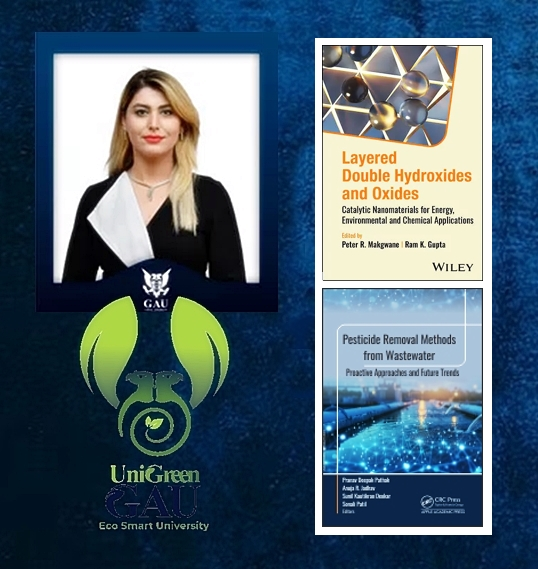
The research conducted by Assoc. Prof. Dr. Paria Eghbali Toularoud, Vice Dean of the Faculty of Pharmacy at Girne American University (GAU), and Head of the Department of Basic Pharmaceutical Sciences and the Department of Analytical Chemistry, has been published on international scientific platforms, offering innovative treatment approaches to water pollution caused by heavy metals and pesticides.
According to information provided by Assoc. Prof. Dr. Paria Eghbali, the studies to which she contributed examine the impacts of chemical pollutants—whose presence has increased due to industrialization and agricultural activities—on human health and ecosystems, while also evaluating next-generation adsorption and photocatalytic methods for their removal from water. Commenting on the issue, Eghbali stated: “These pollutants pose serious risks to human health. Therefore, their effective removal from aquatic environments is imperative.”
WHAT IS KNOWN – WHAT IS PROPOSED?
“Layered Double Hydroxide Adsorbents for the Removal of Metal Ions from Water Pollutants”
Layered double hydroxides (LDHs) are materials belonging to the anionic clay group, capable of adsorbing heavy metal ions from water with high efficiency. Owing to their large surface areas and ion-exchange capacities, they enable the selective removal of metal ions. In LDH-based adsorbents, the adsorption process involves surface adsorption, ion exchange, electrostatic attraction, and complexation mechanisms. This study summarizes the preparation, functionalization, recovery, and current applications of LDH-based materials in sustainable wastewater treatment.
“Carbon-Based Photocatalytic Approaches for Pesticide Removal from Wastewater”
Carbon-based photocatalysts developed to address the increasing presence of pesticides in environmental systems—particularly activated carbon-supported systems—stand out due to their high surface area, porosity, and environmentally friendly characteristics. Through hydroxyl radicals and other reactive oxygen species generated during photocatalytic processes, pesticides are degraded via advanced oxidation pathways. In addition, photocatalytic efficiency is enhanced through persulfate activation, offering more effective and sustainable solutions for pesticide removal. (From the article)
------------------------------------------GAU NEWS / 10.01.2026------------------------------------------
https://www.facebook.com/search/top?q=gau%20media
https://www.instagram.com/gau.media/